
Is your website ready for quantum computers?
U92-Vyu finds the encryption in your website, API or public GitHub code that a quantum computer will break, scores how exposed you are, and tells each team what to fix first. Free and passive, and it takes about a minute.
- No sign-up to see results
- Nothing is attacked or logged into
- Signed report you can verify
What will yours say? Gold rows are post-quantum key exchanges. Vyu offers each of 21 groups on its own and records the server's answer.
The risk, in plain words
Your encrypted traffic can be copied today and read later
This is called harvest now, decrypt later. No quantum computer can do it yet, but data that must stay private for years is at risk from the moment it is recorded.
Recorded today
Anyone on the network path can copy encrypted sessions: logins, payments, API calls. They cannot read them yet.
Happening now
Stored for years
Storage is cheap. Recordings can be kept until the tools to open them exist.
The years in between
Read later
A large quantum computer breaks the RSA and elliptic-curve key exchange that protects almost all of today's traffic.
Expected in the 2030s
The fix for data in transit already exists. Hybrid post-quantum key exchange (X25519MLKEM768, built on NIST's ML-KEM standard, FIPS 203) keeps recordings unreadable. Chrome, Edge, Firefox and Safari already offer it. On most modern stacks your server or CDN needs only a configuration change to accept it, and Vyu tells you whether it does.
Are you already exposed? Try it.
Pick how long your data must stay confidential and when you think a quantum computer will arrive. Customer records under banking or health rules often need ten years or more.
Yes. Traffic recorded since 2025 would still be secret when a quantum computer arrives in 2035.
Every day without post-quantum key exchange adds to what can be read later. Protecting data in transit is the first fix.
What one scan tells you
Six questions your board, auditor or CISO will ask
Each answer comes with the evidence behind it. At the foot of each card is the answer from our sample scan.
Is our traffic safe from harvest now, decrypt later?
Whether your server accepts any of the post-quantum key exchanges browsers now offer, and which it prefers.
How ready are we, in one number?
A readiness score from 0 to 100 and a grade from A to E, with the method printed in the report so anyone can check it.
What cryptography do we actually run?
A cryptographic bill of materials: every algorithm, key, certificate and protocol found, as a CycloneDX file.
Are there known vulnerabilities on our pages?
JavaScript libraries and their versions, matched against published CVEs, plus scripts loaded without integrity checks.
Will our certificates survive the new rules?
Key types and lifetimes against the CA/Browser Forum limits, which fall to 47 days by 2029.
Who needs to do what?
Every issue is ranked and assigned to the team that usually fixes it, with the change to make.
The report
A ten-page report your leadership can read in five minutes
Charts first, detail after. Leave a work email and we send the signed PDF with your CycloneDX file. Pick a page to look inside the sample.
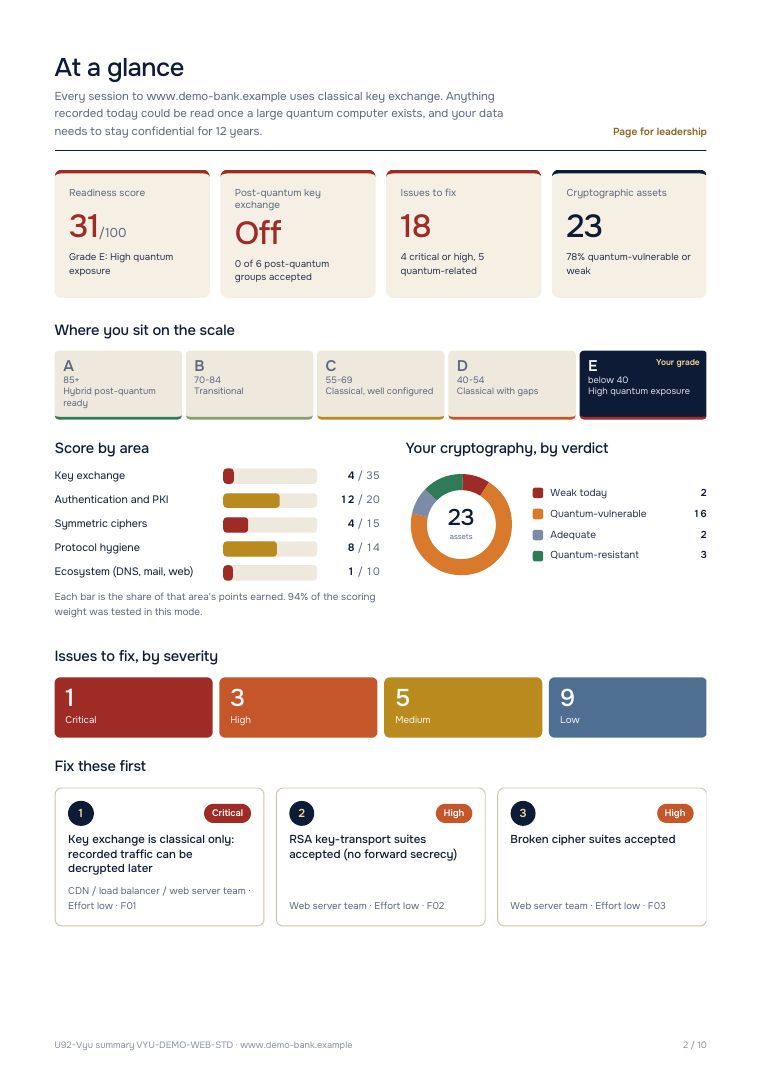
From a scan of our fictional demo bank.
Coverage
What a free scan checks
Only what any visitor's browser or a public API can see. Nothing is logged into, attacked or load-tested.
Websites and APIs
- Post-quantum key exchange: all 21 TLS groups offered one by one, including the three hybrid ML-KEM groups.
- Protocols and ciphers: TLS 1.3 and 1.2, cipher order, forward secrecy, AES-256 versus AES-128.
- Certificate: key type and size, chain, expiry and lifetime against CA/Browser Forum limits.
- DNS and email: CAA, DNSSEC, SPF, DMARC, DKIM key sizes and MTA-STS.
- Web hardening: HSTS, HTTPS redirect, cookie flags, and the CDN or server in front.
- Page scripts (SBOM): JavaScript libraries, versions and known CVEs.
- Login token keys: algorithms and sizes your identity provider publishes.
- Certificate logs: live certificates for your domain and subdomains, from public CT logs.
Public GitHub code
- Crypto in code: RSA, elliptic curves, MD5, SHA-1, DES, RC4, ECB and static IVs across nine languages.
- Post-quantum already in use: ML-KEM, ML-DSA and SLH-DSA in code or configuration.
- Server and cloud config: nginx, Apache, Spring Boot, AWS load balancers, KMS keys, Kubernetes certificates.
- Dependencies (SBOM): packages from ten manifest types, with advisories from the OSV database.
- Committed secrets: private keys and cloud keys, counted by type. Values are never stored.
- Runtimes: Go, Java and base images older than their first post-quantum release.
- CI pipelines: unpinned GitHub Actions, risky triggers and over-broad tokens.
How it works
Three steps, no install, no account
- Step 01
Enter a domain or repository
Confirm you are authorised to request the evaluation.
- Step 02
Watch the checks run
Handshakes, certificates, DNS, mail, page scripts and certificate logs report as each one finishes.
- Step 03
Read the results, get the report
Score and fixes on screen straight away. Leave a work email for the signed PDF and CycloneDX file.
Why you can rely on it
Built to be checked, not taken on trust
Every number in a Vyu report traces back to a handshake, a DNS record, a published key or a line of code, and anyone can verify the report itself.
Engineering
Built from the handshake up
Vyu writes its own TLS handshake messages and offers each key-exchange group on its own, so it sees exactly what your server accepts, including groups an ordinary browser connection would never reveal.
Method
A score you can audit
Five areas with fixed weights, printed in every report. Checks that were not run are left out of both sides, and the report shows the coverage.
Standards
Standards, not opinions
Verdicts follow published guidance, and the inventory uses the format regulators already accept.
Proof
Reports you can verify
Every report and CBOM is signed by UElement. Anyone you share it with can confirm online that it is genuine and unchanged.
covers result, CBOM and PDF (SHA-256)
signed Ed25519 by UElement
✓ signature valid, PDF matches the one issued
Made by U92 Quantum Security at UElement
Our team in Pune builds post-quantum discovery and migration tools. Our founders come from banking and financial services, telecom and global partner alliances, so the report speaks the language of the teams that have to act on it.
Why now
The deadlines have started
An inventory comes first, and regulators are now asking for one.
CERT-In publishes its guidelines on SBOM, QBOM and CBOM, AIBOM and HBOM (version 2.0).
EU member states are asked to have cryptographic inventories in place.
EU coordinated roadmap for transition to post-quantum cryptographyMost duties under India's DPDP Rules apply, including reasonable security safeguards and 72-hour breach reporting.
NIST proposes deprecating RSA-2048 and P-256; the EU expects high-risk systems to have moved to post-quantum cryptography.
NIST IR 8547 (draft) and the EU roadmapNIST proposes disallowing quantum-vulnerable public-key algorithms altogether.
Free and paid
Start free with U92-Vyu. Go deeper with U92-VyuAssure.
Vyu is the free public check. VyuAssure is the paid, per-scan assessment for teams that must show evidence to a regulator, an auditor or a customer.
U92-VyuLive, free | U92-VyuAssureIn build, early access | |
|---|---|---|
| Post-quantum key exchange | Main host on its main port | Every subdomain and TLS port, SSH and mail servers, legacy protocol tests |
| Cryptographic inventory | CBOM of what the scan sees | Full CBOM and QBOM to CERT-In minimum elements, crypto-agility score, migration roadmap |
| Software components | Page scripts and repository dependencies with known CVEs | Full SBOM with transitive dependencies, exploit-likelihood ranking and VEX statements you confirm |
| Code | One public repository, secret counts only | Private repositories, secret locations and git history |
| Exposure | Passive checks only | Owner-approved external vulnerability assessment and performance checks |
| Regulation evidence | Not included | Evidence packs by regulator and country, with a guided questionnaire |
| Report | Signed summary PDF and CycloneDX file | Full signed report, CycloneDX and SPDX files, Excel tracker, re-scan within 30 days |
| Price | Free, work email for the report | Per scan, paid by UPI including Google Pay, card or invoice |
Evidence packs in VyuAssure
Each pack maps scan results to the controls a regulator asks about, adds a short questionnaire for what a scan cannot see, and gives you a gap list and a plan. Reports state the evidence found; they never claim compliance.
After the scan
One scan is the first step of a migration
U92 Quantum covers the whole path, from a free look at your public surface to moving each application onto post-quantum cryptography.
U92-Vyu
A free check of one public host or repository, with a signed summary and CBOM.
Live, freeU92-VyuAssure
Every endpoint, a full SBOM with VEX, and evidence packs for your regulators.
In build, early accessU92-DeepVyu
Internal services, private code, HSMs and key stores, in one signed inventory with a costed plan.
By engagementU92-PQc
Applications moved to ML-KEM and ML-DSA one at a time, with crypto-agility built in.
By engagementQuestions
Is it really free?
Yes. The scan and the results on screen are free, with no account. The signed PDF and CycloneDX file are free too; we ask for a work email so the report reaches the organisation it describes. U92-VyuAssure is the paid, per-scan assessment.
Will the scan affect my website?
No more than a handful of visitors would. Vyu makes short, browser-like connections to one host, one at a time with a pause between each, reads public DNS and certificate logs, and stops. Nothing is logged into or attacked.
Can I scan a site I do not own?
You confirm you are authorised before each scan. The free scan reads only what any visitor can see, but scanning someone else's systems may still need their permission. Deeper checks in VyuAssure always require proof of ownership.
What does “post-quantum key exchange” mean?
Hybrid groups such as X25519MLKEM768 combine today's elliptic-curve key exchange with ML-KEM, the NIST standard FIPS 203. If either part holds, recorded traffic stays private. Browsers already offer it, so turning it on at your server or CDN protects most visitors at once.
Why is my score low when my certificate is valid?
A valid certificate proves identity today. The score weighs key exchange most, because that is what protects recorded traffic. Every finding shows how it was established and how the points were counted.
What is a CBOM?
A cryptographic bill of materials: a list of every algorithm, key, certificate and protocol a system relies on, with where it was found. It is the first step in any post-quantum migration, and both the CERT-In and EU guidance ask for one.
What happens to my data?
Scan results are kept for 30 days so you can come back to them, then deleted. If you request the report, we keep your name and work email to send it and, if you agree, to follow up. Secret values found in code are never stored.
See what your server says in about a minute.
Free, passive and signed. Every post-quantum plan starts with knowing where you stand.